The bloom in pour-over: why fresh coffee needs longer.
The first pour in a pour-over is short but decisive. During the bloom, carbon dioxide escapes from the grounds. Give it enough time and your coffee extracts more evenly afterwards.
What happens during the bloom
Roasting creates carbon dioxide, which stays trapped in the beans and escapes slowly over weeks. When hot water hits the grounds, part of that gas is released at once: the coffee bed rises and bubbles. As long as gas is escaping, it keeps water away from the grounds and the extraction becomes uneven. The bloom gives the gas time to escape before the main pour begins.
How much water, how long?
For the bloom, about two to three times the coffee dose is enough to wet all the grounds evenly. Shotbook plans with 2.5 times the dose, so 50 g of water for 20 g of coffee. The bloom phase lasts 30 seconds from the start of the first pour, then the next pour follows.
Fresh coffee: 45 instead of 30 seconds
The fresher the roast, the more gas is still in the coffee. If your coffee was roasted less than 4 weeks ago, Shotbook automatically extends the bloom to 45 seconds. All it needs is the roast date.
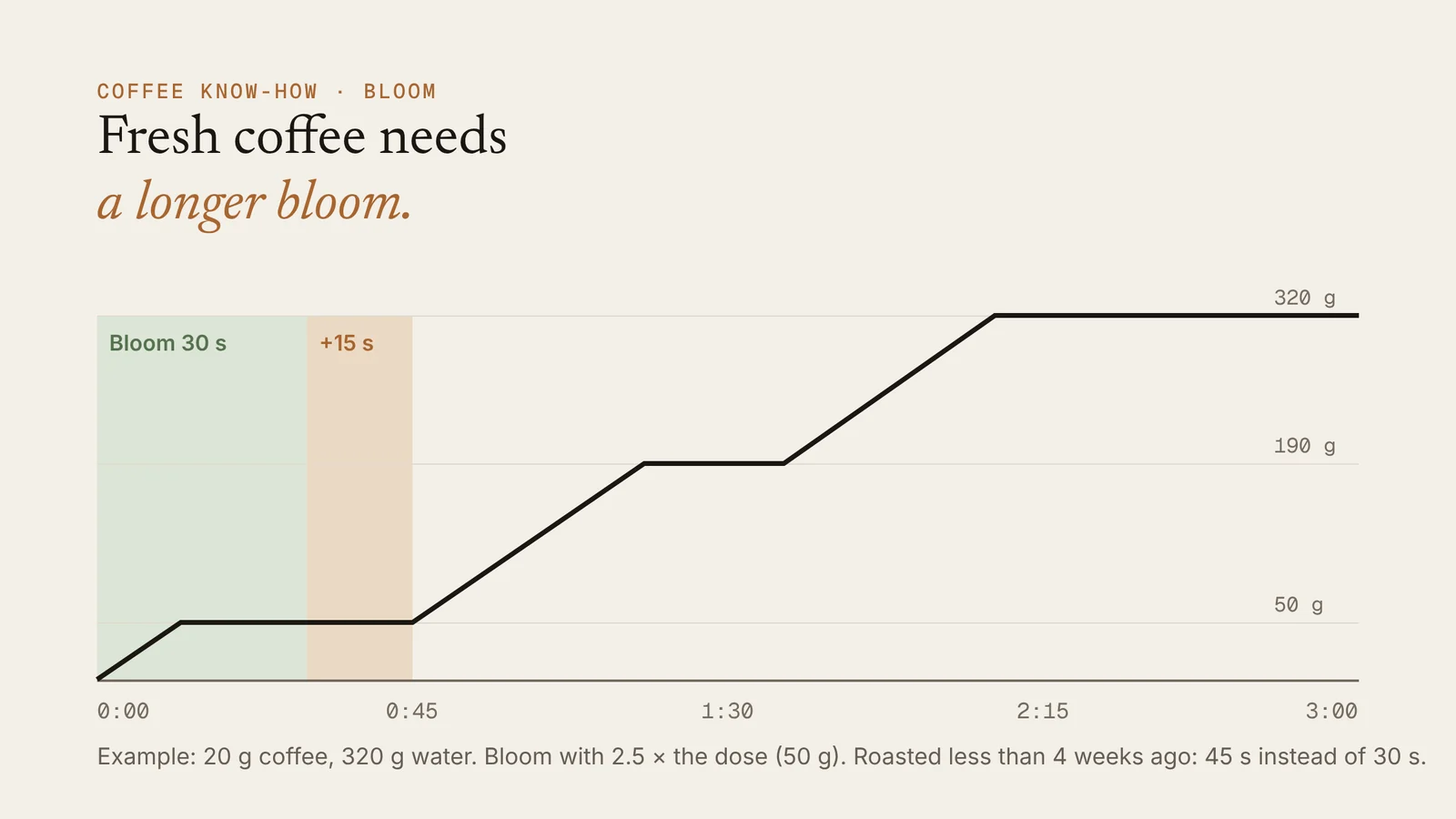
Example recipe: 20 g to 320 g
This is how Shotbook plans a pour-over with 20 g of coffee and 320 g of water (ratio 1:16). Times count from the start of the first pour:
| Step | Roasted over 4 weeks ago | Fresh roast |
|---|---|---|
| Bloom to 50 g | 0:00 | 0:00 |
| Pour to 190 g | from 0:30 | from 0:45 |
| Pause | 20 s | 20 s |
| Pour to 320 g | from 1:23 | from 1:38 |
| Drawdown finished | about 3:00 | about 3:00 |
Both versions finishing at about 3:00 is intentional: the longer wait at the start comes off the drawdown, the total time stays the same.
Common questions
01Do I need a bloom with older coffee too?
02Should I stir or swirl during the bloom?
03Does this apply to AeroPress or French Press too?
Keep reading
 Taste · 4 min read
Flavour notes and the SCA flavour wheel: why you should rate your own coffee
Read Basics · 4 min read