Flavour and rating: why you should rate your own coffee.
“Notes of cherry and milk chocolate” says the bag, and in the cup you taste coffee. That is normal. Tasting is practice, and the easiest practice is to rate every brew briefly and note what you taste.
What is the flavour wheel?
The Coffee Taster’s Flavor Wheel was re-released in 2016 by the Specialty Coffee Association (SCA) and World Coffee Research. It is based on a scientific sensory lexicon and gives baristas, roasters and drinkers a shared vocabulary. General categories sit in the middle, and the terms become more specific towards the outside.
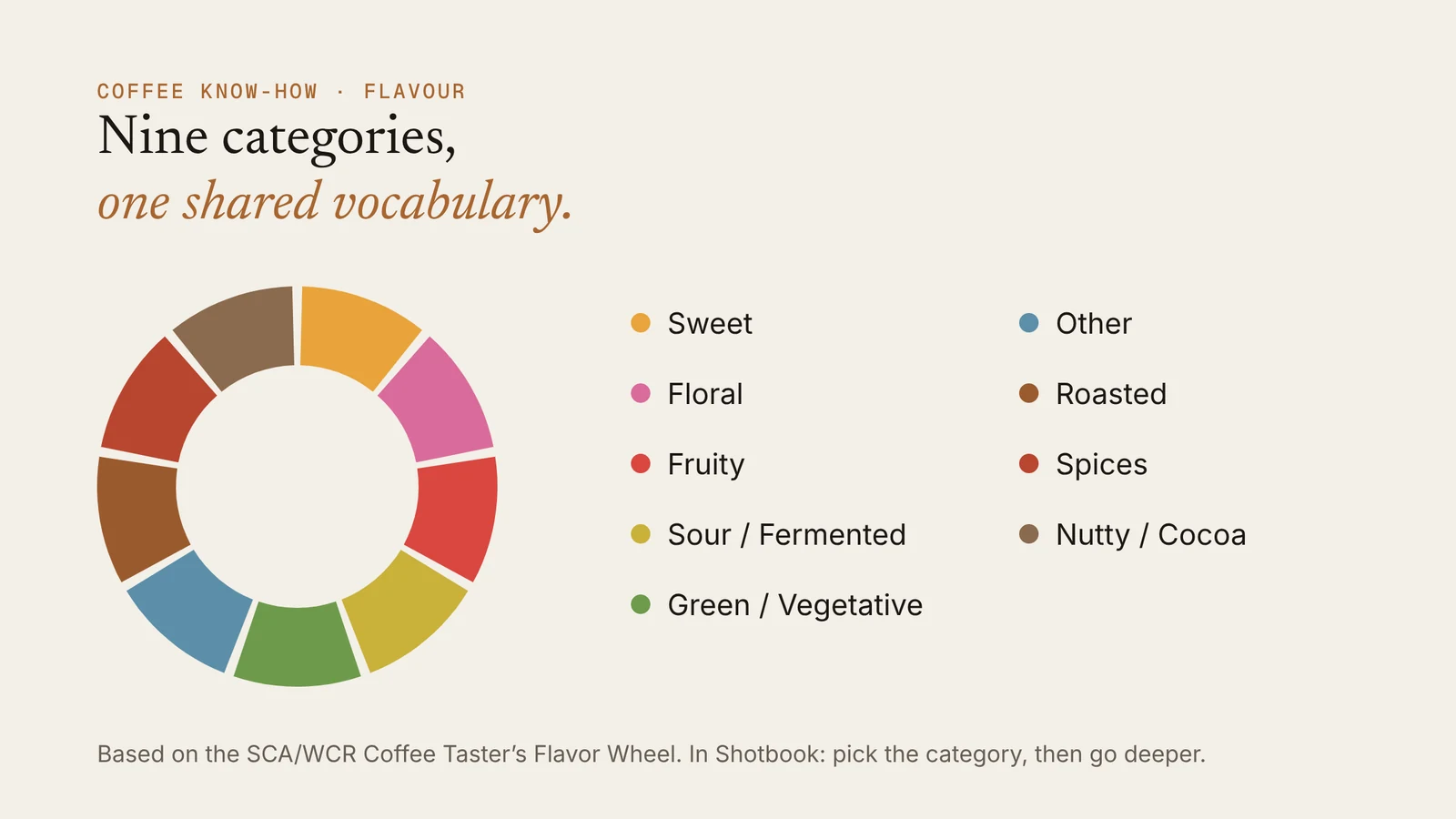
The nine main categories are: sweet, floral, fruity, sour/fermented, green/vegetative, roasted, spices, nutty/cocoa and other (for example papery or chemical, mostly off-notes).
How to pick out flavours
- From the inside out. First just ask: more fruity, more nutty, more roasted? Only then: which fruit? Berry or citrus?
- Let it cool. Very hot coffee hides a lot. As it gets lukewarm, acidity, sweetness and fruit become clearer.
- Slurp. A little air spreads the coffee across your mouth and carries the aroma to your nose.
- Compare. Two coffees side by side reveal differences far better than one on its own.
Why rate it yourself?
Our taste memory is short. A week later you no longer know whether the shot with 18 g or 18.5 g was better. A quick rating right after the brew turns single cups into a history:
- You see what works. If a finer grind regularly gets an 8 instead of a 6, it is no longer a hunch.
- You compare fairly. Coffees, roasters and methods become comparable over weeks.
- You find your taste. The roaster’s notes are a hint, your rating is the truth for your cup.
- You learn to taste. Naming what you taste regularly means you taste a lot more after a few weeks.
A scale you will actually keep using
Your rating does not have to be perfect, just consistent. Shotbook uses a simple scale from 1 to 10, with a word for each step:
| Points | Meaning |
|---|---|
| 1 to 2 | Bad |
| 3 to 4 | Below average |
| 5 | Average |
| 6 | Decent |
| 7 | Good |
| 8 | Very good |
| 9 | Excellent |
| 10 | Perfect |
These points are your personal verdict, not SCA cupping scores. An 8 means: I would happily drink this again exactly like that.
A failed shot does not have to spoil your numbers: discard it instead of rating it badly. That keeps your averages honest.
Common questions
01Do I need to recognise every flavour on the wheel?
02How is this different from SCA points?
03Why can’t I taste the notes from the bag?
Keep reading
 Basics · 4 min read
Specialty coffee vs. commercial coffee: what is the difference?
Read Cologne · 5 min read